The table
Everything that happens on a real table happens here, because the balls are simulated rather than scripted.
How it plays
- Spin that matters. Follow, draw and side all come from where the tip strikes. Side changes the angle off a cushion and throws the object ball.
- Jump and swerve. Raise the butt of the cue to lift the cue ball over a blocker, or to bend it round one.
- Chalk and miscues. Chalk wears off with every stroke and you only get so many goes at it a match. Strike too far from centre on a worn tip and it slips.
- A table that shows its use. Hard strokes scorch the cloth, jump shots dig it, and the tip leaves chalk on the cue ball.
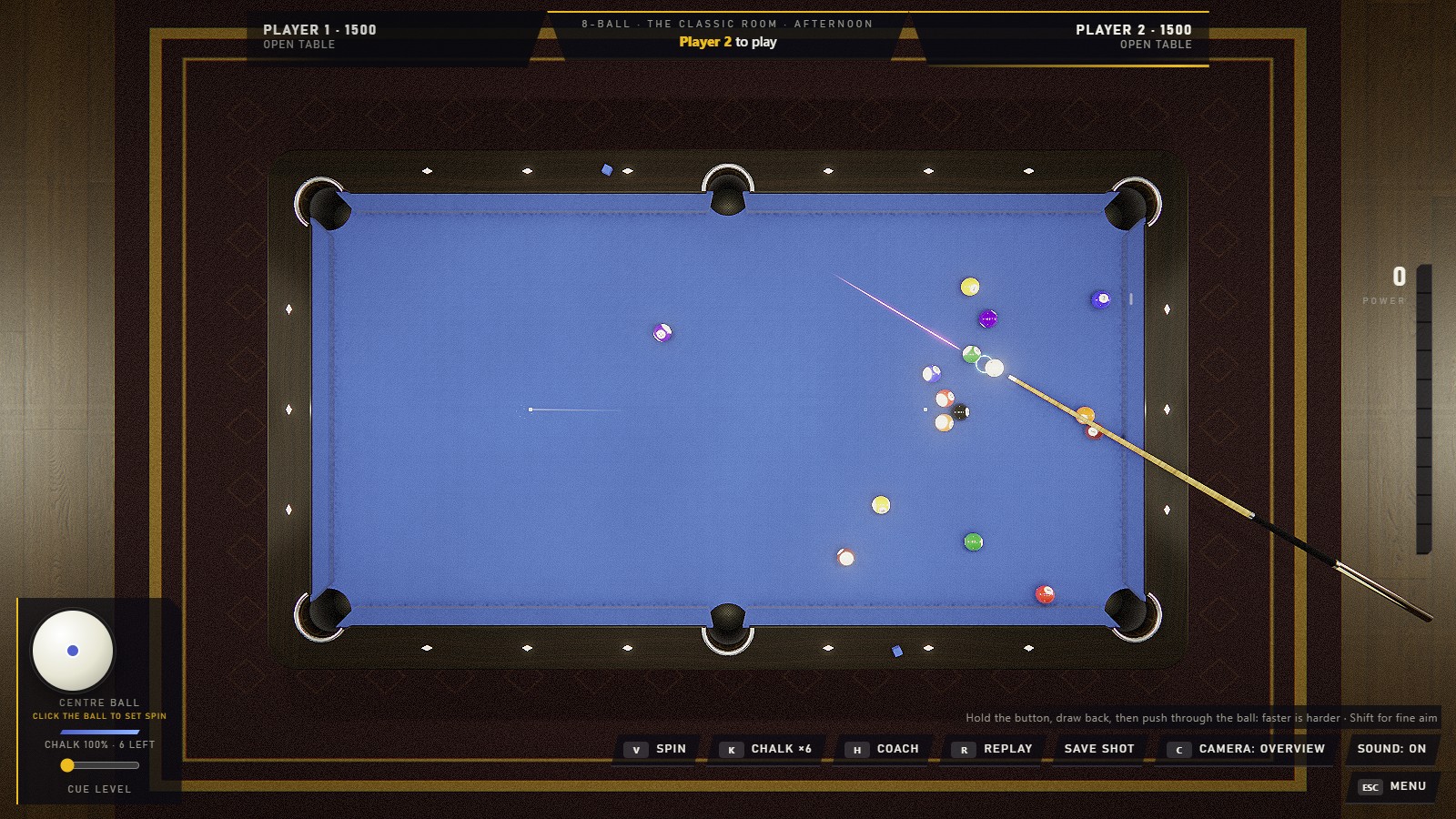
- A stroke you play yourself. Draw the cue back and push it through the ball: how fast you push is how hard you hit. Or pull back and let go, if you would rather.
- Three ways to see it. An overview you can turn and zoom, straight down from above, or first person over the cue.

Three kinds of table
Pool
For seven games, with the small table and pockets of English 8-ball and the tight, rounded jaws of Chinese 8-ball among them.
Snooker
Twelve feet long, with tight, rounded pockets, a baulk line and a D.
Carom
No pockets at all: four cushions that meet in the corners, lines on the cloth for balkline, and a smaller table for four-ball.

Try it, free
The demo is 8-ball in the Classic Room, with its whole spoken tutorial, a practice table and a computer player, for Windows, Linux and macOS. The full game will be sold only on Steam, at $12.99.